
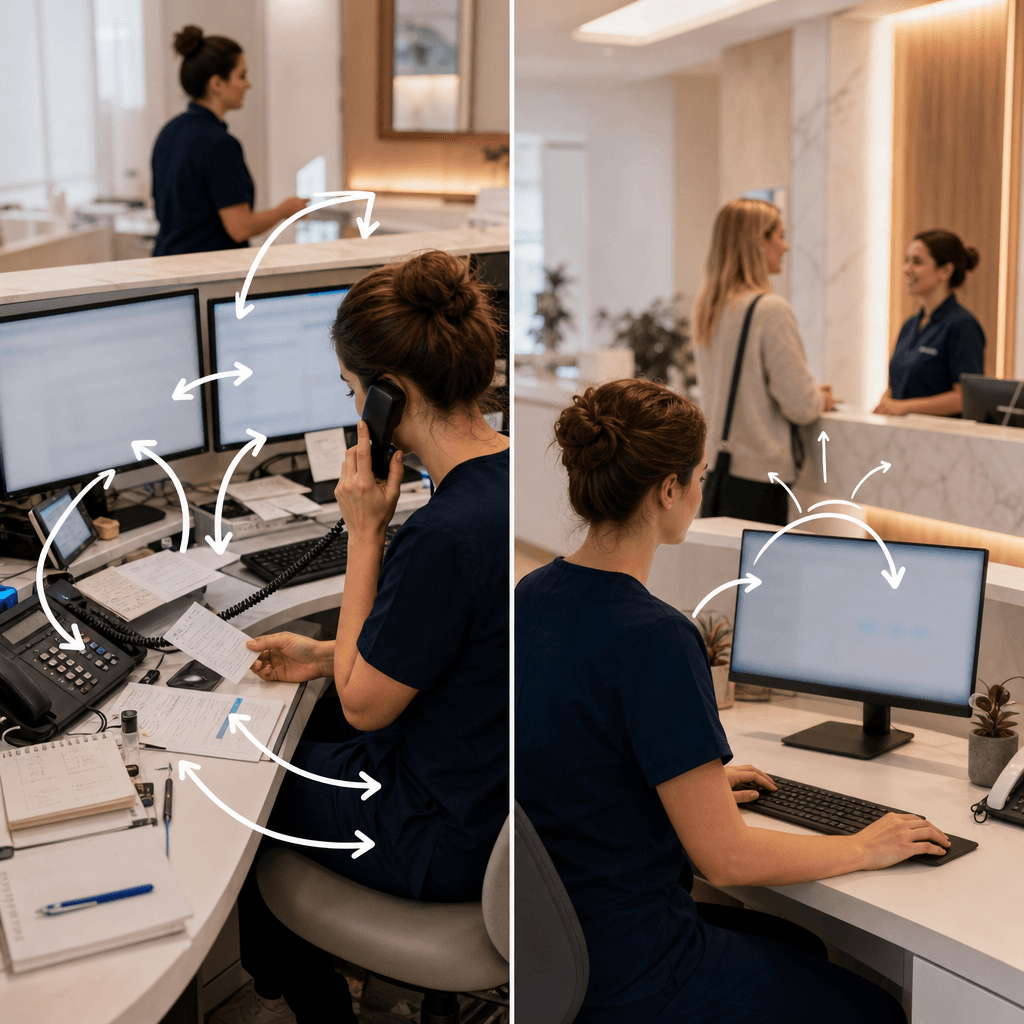
The average dental practice now runs on 8 to 12 different technology tools. That's a lot of software. And when those systems don't talk to each other, someone has to bridge the gap manually. We're seeing front-desk teams lose 8 to 15 hours every week just copying data between platforms, chasing confirmations, and fixing scheduling conflicts that better integration would have prevented entirely.
The integration tax: Why 8-12 tools cost you more than software fees
The software subscription is just the beginning. The real cost hides in what happens after the technology is installed.
We call it the integration tax. A patient calls to reschedule. The receptionist answers, scribbles the details on a sticky note, then manually enters the change into the practice management system while the next caller waits on hold. Meanwhile, the confirmation system sends a reminder for the original appointment because nobody updated it yet. The patient shows up confused. The schedule has a gap. Everyone loses time.
This scenario plays out dozens of times daily in practices where tools operate in isolation. According to recent analysis on dental tech integration, integration quality is the key differentiator between high-performing and struggling practices. The tools themselves matter less than how well they communicate.
The numbers tell the story. Practices with connected systems reduce administrative burden by 30 to 40 percent. Those without? Their front-desk teams become human middleware, translating between platforms that should be talking directly to each other.
The good news: the 2026 cloud stack finally makes it possible to eliminate these manual handoffs between telephony and scheduling. The catch is understanding what real integration actually looks like, versus the marketing version.
"Your team shouldn't be the glue holding your tech stack together."
Where chair utilization leaks: The telephony and scheduling gap
The gap between telephony and scheduling creates a specific kind of failure. A patient calls Tuesday morning to move their Thursday cleaning. The receptionist updates the practice management system, but the confirmation platform already queued a reminder for the original slot. That reminder goes out Wednesday evening. The patient, now confused, assumes something went wrong. They don't show up at all.
This isn't a rare edge case. Research into dental no-show patterns shows that 35 to 40 percent of no-shows happen simply because patients forget their appointments. The frustrating part? Many of these patients actually tried to reach the practice through phone calls, voicemails, or messages that the scheduling system never registered. The intent to communicate was there. The technology failed to capture it.
Recall campaigns face a similar blindspot. Most recall systems batch their outreach without visibility into current phone line status. The result: automated calls flood in during the morning rush when front-desk staff are already handling three conversations. Patients reach voicemail, assume the practice is too busy, and don't call back.
One missed connection creates a gap in the schedule. That gap shifts workload to other days. Staff scramble to fill cancelled slots while managing the regular call volume. By Friday, the compounding effect shows up in overtime hours, stressed teams, and chairs that sat empty when they didn't need to.
The 2026 cloud architecture: How telephony and scheduling finally connect
Something fundamental shifted in how dental software works. The global cloud-based dental practice management market reached USD 1.97 billion by 2026. That number reflects more than growth. It marks a move from static scheduling to predictive capacity optimization.
The old model relied on nightly batch syncs or manual exports. Data moved slowly, if it moved at all. The new architecture looks different. Cloud-native systems share data in real time, with each platform aware of what the others are doing.
The practical difference shows up in everyday scenarios. A patient calls to reschedule their hygiene appointment. The telephony system captures the change and updates the practice management system instantly. That update triggers a new confirmation sequence and adjusts the recall queue automatically. No sticky notes. No second system to update manually. No conflicting reminders going out.
The cloud and AI developments reshaping dentistry point to another capability worth noting: prediction. Integrated systems can now assess no-show risk with 70 to 80 percent accuracy. They analyze patient history, appointment type, and scheduling lead time across connected data sources. High-risk appointments get flagged early, giving front-desk teams time to confirm or fill potential gaps before they happen.
The shift from reactive to predictive changes everything about how practices manage capacity.

"Real-time sync beats a morning scramble, every time."
European practice scenarios: Same tools, 40% better outcomes through integration
A Dutch group practice with four locations was running the same stack as most mid-sized dental groups. Separate telephony, a cloud-based practice management system, and a standalone reminder platform. The tools were fine. The problem was the silence between them.
Front-desk staff spent 12 hours weekly reconciling data across platforms. They copied appointment changes from call logs into the PMS, then manually updated the reminder system to prevent conflicting messages. Despite the effort, 22% of hygiene appointments still ended in no-shows.
The practice didn't replace anything. They connected what they already had through API integration, allowing data to flow bidirectionally between telephony, scheduling, and confirmations.
The results came quickly. No-show rates dropped to 14%. Manual reconciliation time fell to under 2 hours weekly. Staff redirected those recovered hours toward patient care and same-day filling of cancelled slots.
The data supports this pattern across the region. Cloud-based practice management systems combined with automated reminders cut no-show rates by 15% in large group practices, but only when systems share data in both directions. One-way syncs don't deliver the same outcome.
The insight worth noting: these practices didn't buy new technology. They made existing technology communicate. The competitive advantage came from workflow architecture, not feature acquisition. The tools were already there. The connections were missing.
Measuring integration ROI: From phone volume to chair utilization
The numbers make the case clearly. Patient communication platforms reduce front-desk phone volume by 25 to 40 percent. But that reduction only materializes when telephony connects directly to scheduling. Without integration, staff end up handling the same request twice: once on the phone, once in the system.
Confirmation effectiveness follows the same pattern. AI-powered confirmation and scheduling systems reduce no-shows by 25 to 45 percent compared to manual reminders. The higher end of that range? Practices with real-time telephony integration. The lower end? Systems operating in silos where confirmation data never reaches the scheduling platform until someone copies it over.
The administrative recovery adds up fast. The right integrated stack reduces administrative burden by 30 to 40 percent. Hours previously lost to manual data entry and phone-based rescheduling come back to the practice. Staff redirect that time toward patient care, same-day slot filling, and the work that actually grows the business.
The business case writes itself. A practice losing 8 to 15 hours weekly to manual handoffs recovers that capacity within the first quarter of proper integration. Voicelabs Dental sees this pattern consistently across implementations: the ROI isn't theoretical. It shows up in schedules that stay accurate, chairs that stay filled, and teams that finish their day without overtime.
The practices measuring these metrics are the ones improving them. Everyone else is guessing.
Building your integrated stack: Where to start in 2026
The telephony-PMS connection deserves attention first. This single integration point eliminates the highest-volume manual handoff in most practices. Every call that updates the schedule directly, without a sticky note in between, recovers minutes that compound into hours by week's end. An AI dental receptionist that books directly into the practice software removes the largest remaining manual handoff: the phone.
Smart practices evaluate integration depth before features. The question worth asking vendors: does your system offer real-time bidirectional sync, or just data export? The difference matters. Export means someone still copies information manually. True sync means the systems handle it automatically, in both directions.
Hygiene recall presents the clearest opportunity. With hygiene appointments showing the highest no-show rate at 18 to 25 percent, integrating recall campaigns with live phone availability creates the biggest immediate impact. Recall systems that know when the front desk is already handling calls can time their outreach better. Patients reach a person instead of voicemail. Appointments get booked.
AI-native platforms are gaining ground for a reason. Systems built for integration from the ground up avoid the workarounds and limitations of legacy tools connected through middleware. The architecture matters as much as the feature list.
The practices getting ahead in 2026 aren't buying more software. They're connecting what they have.
See how Voicelabs Dental connects telephony and scheduling in one AI-native platform. Request a demo to calculate your practice's integration tax.