
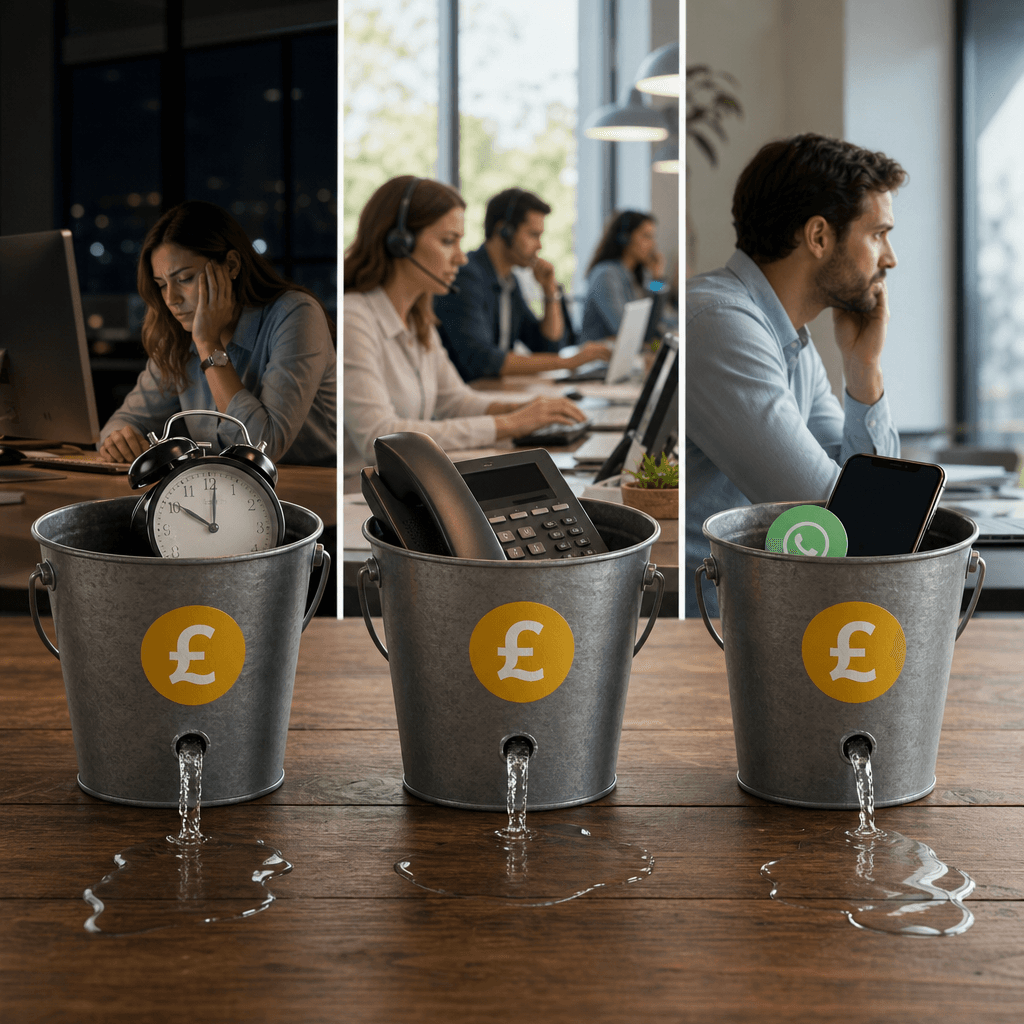
Three missed calls a week. That's the average for UK small businesses, and it adds up to roughly £540 in lost booking revenue every month. The maths is brutal: enquiries answered within the first minute convert up to 391% better than delayed responses. Wait an hour, and your chances of qualifying that lead drop sevenfold. Most business owners know they're missing calls. What they don't always see is the compound cost of inaction, or how an AI receptionist for small business operations can plug that revenue leak.
The three revenue leaks draining your business
The £540 monthly figure comes from three distinct sources. Understanding where the money actually goes matters more than the headline number.
Leak one: after-hours calls. Evenings, weekends, bank holidays. Customers still want to book, but voicemail picks up instead. Most people don't leave messages. They call the next business on their list.
Leak two: daytime overflow. Staff are serving customers face-to-face, stuck in meetings, or juggling multiple enquiries at once. The phone rings. Nobody can answer. Another potential booking slips away.
Leak three: the response time penalty. Even when a message does come through via WhatsApp or SMS, slow follow-up kills conversions. The data from Velocify's analysis of 3.5 million leads is clear: respond within an hour and you're seven times more likely to qualify that lead. Wait longer, and competitors who moved faster have already won the business.
Here's what smart business owners are doing before comparing AI receptionist features or pricing. They're running the numbers first. How many calls actually go unanswered each week? What's the average value of a booking? The calculation often reveals whether there's a genuine problem worth solving, or whether the issue is smaller than assumed.
Some businesses find the leak is barely a trickle. Others discover they're losing thousands.
The 391% conversion penalty you might not know about
The Velocify study of 3.5 million leads revealed something striking: enquiries answered within the first minute convert up to 391% better than delayed responses. Harvard Business Review research backs this up. Responding within the hour makes businesses seven times more likely to qualify a lead.
The penalty compounds across channels. A missed call followed by a slow WhatsApp or SMS reply doesn't just lose one opportunity. It signals to potential customers that responsiveness isn't a priority.
Step 1: Count weekly missed calls. Most phone systems track this automatically.
Step 2: Multiply by average booking value. A £75 service with four missed calls per week equals £300 in potential weekly revenue.
Step 3: Apply the conversion penalty. Delayed responses drop qualification rates by roughly 85%. That £300 shrinks to around £45 in actual recovered bookings.
Step 4: Factor in competitor speed. When one business responds in seconds and another takes hours, the faster response wins almost every time.
According to research on AI voice solutions for small businesses, 91% of customer service leaders feel pressure to implement AI in 2026. The conversion data explains why. An AI answering service eliminates the response delay entirely, whether the call comes at 2pm or 2am.
The businesses running these calculations often discover the cost of inaction exceeds the cost of automation.
UK pricing tiers: What you actually pay in 2026
The market has matured enough that pricing is now transparent. Entry-level options start at £32/month for 100 minutes through RingCentral AIR as an add-on. That suits businesses with genuinely low call volumes, perhaps a consultant or solo practitioner fielding a handful of enquiries daily.
Mid-tier packages sit around £49/month for 150 minutes with providers like Ringmere. This covers most small businesses with moderate enquiry rates. Enough headroom for busy periods without paying for capacity that goes unused.
The technology has caught up with expectations too. UK-hosted solutions now achieve approximately 620ms end-to-end response times, according to Worktual's benchmarks. That's fast enough for conversations to feel natural rather than stilted.
Adoption tells its own story. More than 11,800 businesses globally now use AI receptionists across healthcare, financial services, legal, and hospitality sectors. The use cases vary, but the economics stay consistent.
Compare these figures against traditional call answering services. Human-staffed alternatives typically cost £100 to £300 per month for similar coverage. The gap explains why the virtual receptionist market reached $4.64 billion in 2026, projected to hit $10.85 billion by 2035 at a 9.8% CAGR.
For businesses losing £540 monthly to missed calls, even the mid-tier option pays for itself within the first week. The maths tends to settle most debates.

The ROI calculation: When AI pays for itself
The maths on this one is unusually straightforward. If missed calls cost £540/month and a virtual receptionist costs £49/month, the net gain sits at £491. Most business investments require complex projections. This one doesn't.
The break-even calculation is even simpler. Divide the monthly AI cost by your average booking value. A £75 service means the system pays for itself after recovering a single booking. Everything beyond that is pure upside.
The market tells its own story: £4.64 billion in 2026, projected to reach £10.85 billion by 2035. That 9.8% annual growth rate reflects thousands of businesses running similar calculations and reaching the same conclusion.
Staff time adds another layer to the ROI equation. Nearly 80% of businesses plan to transition agents into new roles as AI handles routine enquiries. Reception staff stop answering "What time do you close?" and start doing work that actually needs a human. The time recovered has its own value, even if it's harder to quantify on a spreadsheet.
Integration multiplies the return further. Modern AI receptionists connect directly with CRMs, Calendly, Shopify, and WhatsApp. A booking confirmed at 11pm syncs automatically. No morning admin catch-up required.
The businesses running these numbers typically find one thing: the cost of the technology isn't the real question. The cost of not having it is.
How AI capability has changed the decision
The technology has shifted faster than most business owners realise. Stanford's HAI 2026 AI Index reveals that AI agent success on real-world tasks jumped from 20% in 2025 to 77.3% in 2026. That's not incremental improvement. That's a capability leap that changes the entire conversation.
- The capability gap between AI and human receptionists is closing rapidly for routine calls. Booking confirmations, opening hours, appointment changes. AI handles these at near-human quality now.
- Modern AI receptionists manage inbound SMS alongside voice, with direct integrations to booking systems, WhatsApp, and CRM platforms. A comprehensive guide to small business phone systems notes this multi-channel capability as a key differentiator from legacy solutions.
- Call monitoring and conversation quality controls matter more than raw features. The best providers offer dashboards showing exactly how calls are handled, with options to review and refine responses.
- UK data residency and GDPR compliance aren't optional extras. Any AI receptionist for SMEs worth considering should host data domestically and provide clear documentation on privacy practices.
- Integration depth varies significantly between providers. Surface-level CRM connections differ from systems that actually update customer records, trigger follow-ups, and sync calendar availability in real time.
The 77.3% success rate explains why adoption has accelerated so sharply. Businesses evaluating AI receptionists today face a fundamentally different decision than those who looked twelve months ago.
Making the decision: Your diagnostic checklist
The businesses getting this right tend to follow a similar pattern. They treat the decision as a data exercise rather than a gut call.
- Two weeks of tracking reveals the real picture. Most phone systems already log missed calls by time of day. Sorting these into after-hours, daytime overflow, and delayed responses shows exactly where revenue is leaking. The numbers often surprise business owners who assumed the problem was smaller, or larger, than reality.
- Revenue leak calculation is straightforward maths. Missed calls multiplied by average booking value gives the monthly cost of inaction. A salon missing six calls weekly at £65 per appointment faces a different calculation than a consultancy missing two calls at £200 each.
- Pricing tier selection follows volume. Businesses handling fewer than 25 calls weekly typically find the £32/month entry tier sufficient. Higher volumes point toward the £49/month option. Providers publish minute allowances clearly now, which makes matching easier.
- Integration audit prevents headaches later. CRM, calendar, and WhatsApp connections matter more than feature lists. A system that syncs bookings automatically saves hours of admin. One that doesn't creates more work than it solves.
- Trial periods expose what marketing won't. Call quality, response latency, and conversation handling vary between providers. A week of live testing reveals whether the technology matches the sales pitch.
The diagnostic approach works because it replaces assumptions with evidence. Businesses that run the numbers rarely find themselves second-guessing the decision afterwards.
Calculate your missed call costs with Voicelabs and see which AI receptionist tier fits your business. Start your free assessment today.